
Sniffing Out Corrosion: RCNDE Research Featured in Materials World
Innovative research supported by RCNDE is helping explore new ways to detect corrosion in critical industrial infrastructure, with potential applications across the nuclear sector and beyond.
An article published in Materials World, the magazine of the Institute of Materials, Minerals & Mining (IOM3), highlights advances in non-destructive evaluation (NDE) technologies for detecting and monitoring corrosion in challenging industrial environments.
Entitled Pit Stop: Under the Skin of Corrosion in the Nuclear Sector, the article was written by Pat Liddicott, former RCNDE Director and Management Board member, and explores how emerging inspection technologies could help address some of the nuclear industry’s most demanding asset integrity challenges.
Can we detect corrosion by its smell?
Among the innovations featured is research led by the University of Warwick, supported by RCNDE industrial members, investigating whether corrosion can be detected through the gases and odours released as materials degrade.
The EPSRC-funded project, Sniffing Out Rust in Critical Industrial Areas, explores the development of an electronic nose (e-nose) capable of identifying corrosion beneath coatings and insulation, where conventional inspection techniques can be difficult or costly to deploy.
The research, involving Ines Carotti and Professor James Covington at the University of Warwick, investigates whether different materials and corrosion processes produce distinctive chemical signatures that can be detected using sensors.
Such technology could eventually provide a new approach to monitoring critical infrastructure, potentially enabling remote corrosion detection using robotic platforms or drones, particularly in hazardous or hard-to-access environments.
Connecting research with industrial challenges
The article also highlights RCNDE’s role in bringing together universities and industrial partners to develop innovative NDE technologies that respond to real-world inspection challenges.
Corrosion detection is a shared priority across multiple sectors, including nuclear, energy, petrochemical and manufacturing. By supporting collaborative research, RCNDE helps accelerate the development of technologies with the potential to improve asset reliability, reduce inspection costs and enhance safety.
The University of Warwick research provides an example of how RCNDE’s collaborative model can support innovative approaches to longstanding industrial challenges, creating opportunities for technologies to be applied across different sectors.
Read the full article
The Materials World feature provides a wider perspective on corrosion challenges in the nuclear industry and examines emerging inspection technologies, including advanced ultrasonics, electromagnetic acoustic transducers and remote sensing.
We would like to thank Pat Liddicott for highlighting RCNDE and the University of Warwick research, and IOM3 for making the article freely accessible to the wider NDE community.
Read the full article: Pit Stop – Materials World (IOM3)
Originally published in Materials World, 21 July 2026. Author: Pat Liddicott CEng FIMMM. Reproduced here as an introduction with permission to link to the original IOM3 publication.


BINDT Roy Sharpe Prize 2025-26 awarded to RCNDE Academic Director, Professor Gareth Pierce

The BINDT 2025-26 awards were presented during the NDT 2026 Conference. The Roy Sharpe Prize is awarded in recognition of a significant contribution through research and development in NDT to the benefit of industry or society. This prize is awarded by the NDT Technical Committee of the Institute. The Roy Sharpe Prize for 2025 is awarded to Professor Gareth Pierce, University of Strathclyde, UK. For more information, visit: https://lnkd.in/e5fSgMMt
Proud to celebrate Professor Gareth Pierce, RCNDE Academic Director, on receiving the prestigious Roy Sharpe Prize. Congratulations on this well-earned recognition and continued success.
The Ultrasonic Industry Association (UIA) annual conference 4-6 May 2027
The Ultrasonic Industry Association (UIA) annual conference will be hosted by C-MIU at the University of Glasgow in 2027 from 4th – 6th May, in partnership with the Centre for Ultrasonic Engineering, University of Strathclyde.
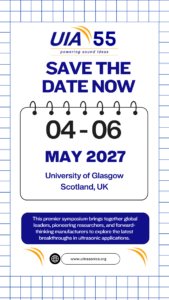
UIA conf May27


Publication of report on “Civil Structures workshop”

We are pleased to announce the publication of the report on the “First Workshop on NDT, CM and SHM requirements for Civil Structures”. It is available to download from the BINDT
website at
https://www.bindt.org/admin/Downloads/2022_Civil_Structures_Requirements_Workshop_Report.pdf
The Workshop was held at the Institution of Civil Engineers in London on 28-29 June 2022 and was sponsored by BINDT, the UK Research Centre in NDE (RCNDE), Construction Industry Research and Information Association (CIRIA) and Infrastructure Industry Innovation Partnership (i3P).
Its main objective was to draw the Civil Engineering and inspection communities closer together so that there was a greater understanding of the challenges and constraints faced by Civil Engineers in inspecting structures such as bridges, tunnels and roads, and to identify opportunities where NDT, CM
and SHM techniques could be applied to provide a benefit. The Workshop brought together owners, operators, regulators, insurance companies, inspection and refurbishment service providers, academics and Research & Technology Organisations.
Over two days the Workshop discussed the drivers faced by the Civil Engineering community, the main forms of damage and degradation encountered in a range of structures, and experiences of applying NDT, CM and SHM techniques in the field. It also described some potential inspection improvements by transferring technologies from related fields. The Workshop concluded by formulating a set of actions to help the Civil Engineering and Inspection communities work more closely and productively in the future.
One key outcome was the creation of the BINDT Civil Engineering sub-group which reports to the Technical Committee. This sub-group, which is now active, is a forum where people can meet to discuss technical issues, training and certification requirements, research needs, dissemination events etc. that relate to Civil Engineering and NDT/CM/SHM. If you are interested in participating please contact Eleanor Flower at BINDT (eleanor.flower@bindt.org).
RCNDE January 2025 Warwick Events
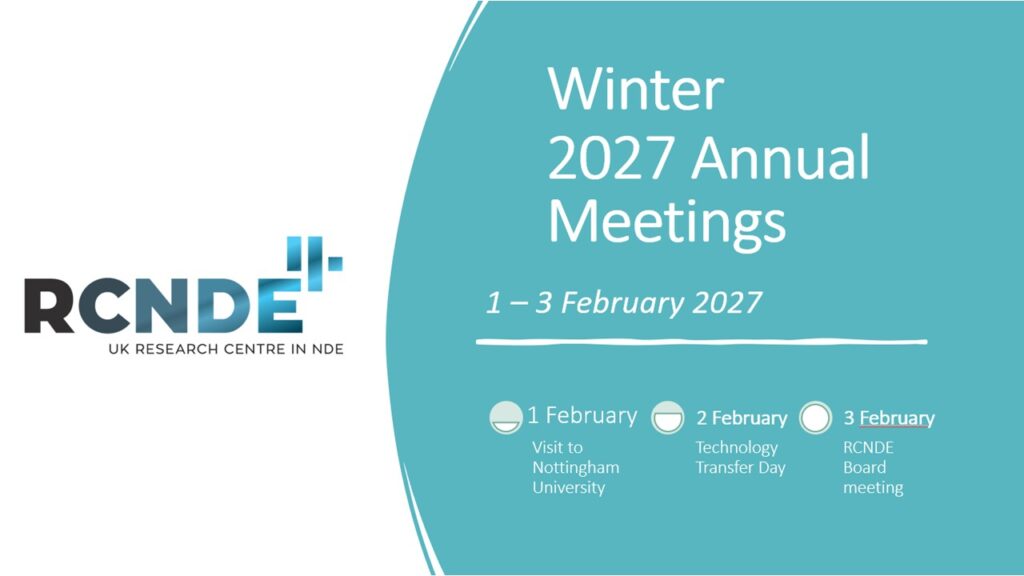
The RCNDE winter meetings were hosted by The University of Warwick from 27th – 29th January 2025 
Monday 29th January opened with the Industrial Working Group where attendees were welcomed by Dr Colin Brett at Millburn House, University of Warwick.
This was followed by Industrial Working Group Talks delivered by Martin Coates from Bae Systems, Liam Harrison and Bernard McGrath from Amentum and Thomas Poon from Rolls Royce.
In the afternoon attendees were able to enjoy tours of the labs and facilities of the Department of Physics and the Warwick Manufacturing Group (WMG).
The NDE research group at the Department of Physics has a focus on ultrasonics with key expertise in EMATs and laser ultrasonics, electromagnetic techniques such as eddy current arrays, novel techniques such as liquid crystal sensors, and flow measurement. There is also work ongoing with developing new magnetometers. The WMG hosts a wide variety of industrial research, with strong links with Tata and Jaguar Land Rover. They host a suite of metrology instruments, including X-Ray facilities, as well as activities in laser-welding, with applications in metrology, applied visualisation but also in forensics and bioengineering. 

The attendees were shown different practical demonstrations such as the use of EMATS to measure residual stress in metals (Steve Dixon, Warwick / Mark Potter, Sonemat), whose application to rail wheels has already been incorporated into BSEN testing standards. They also enjoyed a demonstration on Tensor gradiometry with a diamond magnetometer for imaging damage in steel (Alex Newman, Warwick) which can be used for nuclear applications, including fusion and fission, but can also be applied to provide scalar measurements for magnetic surveys used in space, medical, geological applications. It was particularly exciting to see the new developments in other more familiar topics for the RCNDE membership such as the Liquid crystal ultrasonic sensors (Martha Turvey, Wariwck) which can be used to explore the performance of transducers at an early stage and the use of EMAT arrays for robotic deployment (Rachel Edwards, Warwick) that can be used in an ample variety of material and industrial contexts.
The Technology Transfer Day took place on Tuesday 29th January at Scarman House Conference Centre. Once again attendees were welcomed by Dr Colin Brett and with Dr Caroline Bull giving an Introduction to RCNDE.
Presentations took place to a large audience of academic, industrial, and associate members. There were contributions as follows:
- Chris Curtis (IVC) – Inspection Qualification for UK Civil Nuclear – Current Status and Challenges
- Mike Laws, HOIS – An introduction to HOIS and our trial programmes
The FIND CDT Team then gave a Future CDT Update for associate members.
This was followed by presentations from:
- Kit Lane (Evident) – An EngD student’s experiences in moving from academia to industry
- Nick Brierley, Diondo – Update on the NDE4.0 roadmap. Requirements for validation discussion
The morning session ended with a Summary presentation of demos. The afternoon opened with Demo Sessions allowing attendees to participate in the following 6 demonstrations.
- Pogo – Peter Huthwaite, Imperial College London
- Diamond Magnetometer – Stuart Graham, University of Warwick
- Smart nose for corrosion detection – Ines Carotti, University of Warwick
- Virtual X-ray CT Pose Optimisation and Physical Implementation – Nick Brierley, Diondo
- Editable custom beamformer for advanced real-time imaging for ultrasonic non-destructive evaluation – Ewan Carcreff, TPAC
- Advanced and Automated Ultrasonic and Eddy Current Array Solutions – Gary Luckett, Evident

The event concluded on Wednesday 30th January with the Board Meeting chaired by Pat Lidicott.
We would like to thank all of our presenters for a varied and interesting programme of research presentations. Also to thank everyone who attended for making these meetings a success.
We are looking forward to seeing everyone again in the spring at the Annual CDT Day and Review Day in Manchester
Season’s greetings

from all at RCNDE, with best wishes for 2025
RCNDE will be closed from 24 December 2024 - 5 January 2025
2025 Feasibility studies and Technology Transfer projects

Our annual RCNDE Feasibility studies and Technology Transfer call is now open for outlines proposals. This funding aims to aid with technology transfer of previous research and/or to test and try new ideas. With a total of £75k funding available, past projects have had values between c. £15k and £30k and lasted between around 6-9months. The projects ultimately address industrial requirements identified by the RCNDE industrial membership in the 2022 NDEvR Vision.
Eligibility is limited to current RCNDE academic partners and maximum project costs allowed are £30k per project.
Deadline for outline proposals is 8th December 2024. For more information and how to apply please get in touch.
2024 Industry-funded call for Core research projects

RCNDE mission of matching research to industry needs by investing in world-class talent is at the forefront of our strategy. Our 2024 Industry-funded call for Core projects aim precisely at that, and will fund projects aimed at developing solutions identified by our industrial members in the 2022 NDEvR Vision.
With almost half a million pounds of funding spread over four years, we hope to continue the successful Core programme which is the backbone of our centre. This funding is only available to current RCNDE universities with projects expected to start in Spring 2025.
Deadline for outline proposals is 13 October 2024.
For more information and how to apply please get in touch.
RCNDE success at BINDT 61st Conference
As it is now tradition, the summer holidays finished for most of the RCNDE community with the attendance to the BINDT Conference, celebrating its 61st edition in 2024.
This year’s conference included the bi-annual RCNDE Showcase, where the whole of Session A is filled with RCNDE research and papers. With over twenty papers and most of the RCNDE universities represented, it was an impressive tour de force of the skills and capabilities from our academic community. Well done t all the speakers and the organisers of the conference,

The Materials Testing Exhibition that takes place every couple of years was hosted alongside the conference. RCNDE was present in stand P13 which hosted a series of demos from some of our academic groups. Special thank you to the volunteers that committed their time to the stand, nothing better than seeing science in action! Many of our Associate members were also present at the Exhibition which was, as always, a great success. 
To top this up, some of our academics and collaborators and our own Technology Director, Colin Brett, were recognised with awards at the Conference. Big congratulations to:
Prof Mike Todd, UC San Diego – Roy Sharp prize for a significant contribution through R&D in any branch of NDT to the benefit of industry or society over a period of 10-15 years or longer.
Prof Gareth Pierce, Strathclyde – Anne Birt Award for a significant contribution to technology innovation, technology transfer or technology strategy in the field of NDT over a period of 5-10 years or longer.
Dr Colin Brett – Personal Contribution award to recognise a valuable and significant personal contribution to the British Institute of NDT and the wider NDT/CM/SHM community by an individual who has contributed to and influenced the wellbeing of the Institute
Prof Wuilang Yin et al, Manchester – William Gardner award for best conference paper
A jam-packed week for many but one that we enjoy and look forward to every year


International Women in Engineering Day (INWED) 2024
International Women in Engineering Day, celebrated on 23 June, is an initiative aimed at raising awareness around the incredible achievement of women engineers. While we recognize that there is still some way to go to ensure equitable representation, job satisfaction, and opportunities for women in engineering, we would like to take this opportunity to spotlight some of the amazing women whose work make the world better and safer. Below, Dr Theodosia Stratoudaki (University of Strathclyde) reflects on her professional journey and her experience of being a woman in engineering.

“My main research is focused on sensing and imaging using light. I use light to generate and detect ultrasound. This is important in order to evaluate the condition of industrial and structural parts and make sure that they are fit to do the purpose they are expected to, perform and that they don’t fail. My research is particularly relevant to applications in extreme environmental conditions such as space, high temperature or nuclear environments. Light is one of the very few types of sensors that can operate in such harsh environments.
I lead the team of Remote Ultrasonics and Laser Enabled Sensing at the Centre for Ultrasonic Engineering of the University of Strathclyde. We are developing hardware, software and signal processing methods for laser ultrasonics, most of them targeted towards NDE.
There is plenty of scope for increasing diversity in NDE. It is very promising to see the NDE community realising why NDE needs diversity and then engineer ways to make things possible for all talent to thrive. It is my pleasure to be part of this community both within my role as a researcher and as a teacher to future NDE scientists and engineers.”
We would like to thank Theodosia for sharing her story, and for being an excellent role model for aspiring women engineers.
RCNDE celebrates International Women’s Day
On Friday 8th March 2024, RCNDE celebrated International Women’s Day by spotlighting some of the outstanding women professionals in its community of experts: Caroline Bull, RCNDE Director and Product Engineering Technical Outreach Lead for AWE; Pat Liddicott, Materials Science and Non-Destructive Evaluation Centre of Expertise Lead at Sellafield Ltd; and Dr Rachel Edwards, part of the Ultrasound Group in Physics and Associate Academic Director of the Warwick Institute of Engagement at the University of Warwick. In a series of posts, they are sharing with us their achievements, their experience in the field, and their reflections on the – often bumpy – road towards the greater representation of women in NDE and true gender equality. You can find their stories below and on our social media.
Caroline Bull, RCNDE Director and Principal Engineer, AWE

“I started work in Nondestructive Testing age 17 at UKAEA Harwell, completing key research and inspecting plant and infrastructure across industry sectors worldwide to support the safe running of plant. I have taken opportunities and stepped outside of my comfort zone numerous times, all of which has made me the person I am today.
I have been honoured to be the Director of the UK Research Centre for Nondestructive Evaluation (RCNDE) for nearly two years and lead the successful industry-academia collaboration which has been supporting world-class research, delivering industry benefits, developing NDE professionals for the future and delivering excellence with impact for over 20 years.
Along the way I have met some fantastic women from across the world, who like me, are doing their best to overcome the challenges they face. Often early in my career, this was being the only women working on an inspection.
On International Women’s Day I would like to recognise all women from across the world and encourage all of us to keep going, celebrate our achievements and make a difference in whatever way we can to the world we all live in.”
Patt Liddicott, RCNDE Management Board Industry Chair and Materials Science and Non-Destructive Evaluation Centre of Expertise Lead at Sellafield Ltd

Pat Liddicott is the Materials Science and Non-Destructive Evaluation Centre of Expertise Lead at Sellafield Ltd and manages a small team of materials specialists in the Spent Fuel Management Strategy and Technical team. She is a Chartered Engineer and a Fellow of the Institute of Materials, Minerals and Mining and the current Industrial Chair of the RCNDE Management Board. Prior to joining Sellafield Ltd, Pat worked in the shipbuilding and engineering industries having started her career in the 1980’s as a student apprentice metallurgist and progressed to the position of Principal Engineer; during this time, she was the only female engineer in the section. Throughout her career, she has had an interest in how and why materials fail and the links between structure of materials and their properties and overall integrity and non-destructive test methods play a large part in this. Since joining BNFL (now Sellafield Ltd) Pat has been involved in recruiting the next generation of materials engineers and over the last decade a good gender balance has been developed within the materials community, and the Technical profession in general, at Sellafield Ltd. Non-destructive evaluation could be considered a niche career that is male-dominated, but it is encouraging to see a better gender balance of students undertaking PhDs and EngDs supported by RCNDE.
Dr Rachel Edwards, researcher at the Ultrasound Group in Physics and Associate Academic Director of the Warwick Institute of Engagement at the University of Warwick

“I am part of the Ultrasound Group in the Department of Physics at the University of Warwick. I research different applications of ultrasound in engineering and materials science, with a particular focus on non-contact methods of generating ultrasound, such as EMATs. My background is in physics and materials characterisation, so I am also using EMATs to measure new magnetic materials. I am also developing new methods for engaging different public audiences with Physics / NDT / STEM, and working to encourage more researchers to work with the public.
I got into NDT by accident – I was returning from a postdoc in physics in the US, and the postdoc position at Warwick seemed really interesting. It was good to be able to use physics to do something immediately useful.
The CDTs have been very effective at getting more diversity into NDT, and it is fantastic seeing some of the women from early cohorts now in leadership positions. There is still a lot more work still to be done to ensure NDT is more equitable, but things are definitely improved from when I started in the field.”
We would like to than Caroline, Pat, and Rachel for sharing their stories, as well as the rest of the fantastic women that contribute their knowledge and energy into making RCNDE a leading centre in NDE.


RCNDE 2023 Annual Review Meetings
Our 2023 Annual Review and associated meetings are just around the corner. This year we will be visiting Liverpool, home to one of RCNDE’s newest Academic Members, the University of Liverpool.
Meetings are open only to RCNDE members and are an excellent opportunity to network and stay up to date with the research undertaken in RCNDE and its associated Centre for Doctoral training, FIND CDT.
The schedule for the week is as follows:
24th April 2023 – Industrial Working Group and visit to the University of Liverpool’s Digital Innovation Facility, Structural materials and mechanics lab, and Optical Coherence Tomography technique lab.
25th April 2023 – Centre for Doctoral Training Day – presentations from the students of FIND-CDT, which is associated with RCNDE.
26th April 2023 – RCNDE annual review – presentations on the current RCNDE research programme.
27th April 2023 – ‘Skills for NDE 4.0. workshop’ and RCNDE Board meeting.
We are looking forward to seeing new and familiar faces at the events and hope this is once again a thought-provoking and interesting week for all involved.


NEW project aims to revolutionise manufacturing
A £1.4 M pioneering new project examining how ultrasonic imaging can be delivered remotely aims to revolutionise the quality of manufacturing processes.
The three-year project, funded by the Engineering and Physical Sciences Research Council (EPSRC) is aiming to develop a new capability for real-time, remote ultrasonic imaging that can be used for non-destructive evaluation in industry.


EPRI High-Temperature Sensor workshop
The Electric Power Research Institute (EPRI) held a Workshop on Technologies for Advanced NDE at High Temperatures on 30th September to summarise the state-of-the-art for performing inspections at more than 350°C. The aim was to build a network of vendors and technology researchers to facilitate collaborations in this area, with future nuclear builds being a key driver.

HOIS energy conference, 5-6 October 2021
For the latest in NDE technologies and research, RCNDE’s virtual stand at the 1st HOIS World Conference on Digitalisation of Inspection and Asset Integrity in the Energy Industry is well worth a visit. Our first virtual exhibition, we are sharing our unique perspective as a bridge between industry need and the latest NDE research. Continue Reading

RCNDE features in BINDT Webinar Week
We are proud that many of our members and academic partners featured in the The British Institute of Non-Destructive Testing (BINDT)’s NDT 2021 virtual Webinar Week from 6-10 September 2021. Continue Reading

ARTICLE – NDT: The Unsung Hero
Professor Robert Smith, Director of RCNDE, explains the crucial role that NDT plays in our every day lives in an article written for Quality Magazine. While its influence is evident now, he stresses how it will continue to be pivotal in the future, playing a central role in the fourth industrial revolution or Industry 4.0: “NDT will make greener air, land and sea travel possible and affordable by increasing confidence in structural design, allowing lighter-weight structures and reducing fuel consumption.”